Sunday, June 16, 2013

Tolkien Weekly

Hi, everyone!  I've had a lot of positive feedback on the Tolkien piece that I wrote, so I'm going to try to write a little bit in the Lord of the Rings world every week.  This may include poems, discussions on different parts of the literature, and hopefully another fan fiction piece sometime in the future.

Here's a little quote from The Hobbit:

"Good morning!" he said at last. "We don't want any adventures here, thank you! You might try over The Hill or across The Water." By this he meant that the conversation was at an end.


Like Bilbo, you may be a little bit reluctant to embark on this adventure.  But if you follow along, I think that we'll have a swell time.  Together, we'll delve into the classic world of Elves, Orcs, dragons, and wizards.

Wednesday, May 15, 2013

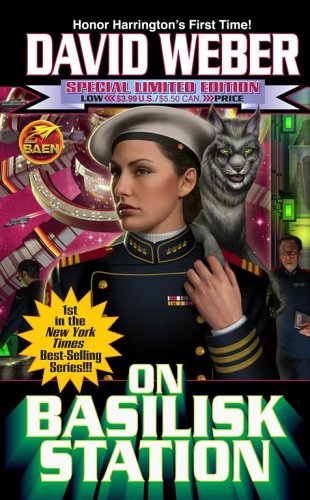
On Basilisk Station

On Basilisk Station by David Weber is the first novel in the Honor Harrington series.  I hadn't read one of Weber's books before, but I'd always heard good things, and I wasn't disappointed.  The book more or less reads as a military science fiction novel, one of the best that I've read in this category.  Weber's description of what future space naval combat might look like was particularly engaging; the stress and combat energy practically boils out of the pages and will have you sitting on edge while you read. In addition, I think that Harrington is a very likable and well-rounded heroine, which no doubt has contributed to the remarkable success of the series.


At a few points the novel does get bogged down in details, however.  Discuss of military procedures gets tedious at times, and at one point Weber simply info-dumps a large section describing the logistics behind space travel on his readers.  While it was quite interesting to me, by the end of it even I was tempted to just start skimming.  One more minor complaint I had was that I felt much of the strong language in the novel was unoriginal.  I understand that Weber was going for a realistic combat situation, but he could have been more imaginative with swearing and colorful expressions. 

Overall, On Basilisk Station was an enjoyable read and I look forward to reading more of the books in the series.  It hasn't replaced Ender's Game or The Dark Wing as some of my favorite military fiction books, but it's definitely up there.  And if you have a Kindle, you can download and read the book for free!

Friday, May 10, 2013

Bussard Ramjet: Efficacy as an Interstellar Space Transport

This is a paper that I wrote involving the notion of the Bussard ramjet and its theoretical use in science and in literature.  I think that it's quite interesting.  Enjoy!


Bussard Ramjet:  Efficacy as an Interstellar Space Transport

By Matthew Michel


Abstract

The portrayal of the Bussard ramjet in popular fiction is generally positive; it allows humanity to travel to other stars under a velocity nearing the speed of light.  The concept uses interstellar gases to generate nuclear energy, which in turn propels a starship.  Several popular works of fiction will be examined and then juxtaposed against scientific papers proposing the effectiveness of the Bussard ramjet.  Based on both scientific probability and proposed use in fiction, a verdict will then be formed regarding the efficacy of the Bussard ramjet as an interstellar space transport. 

Introduction

The Bussard ramjet is an interstellar vehicle first proposed to the scientific community by Robert W. Bussard in 1960 in his work entitled Galactic Matter and Interstellar Flight.  In its simplest form, a ramjet is a theoretical fusion rocket that uses electromagnetic fields to scoop up hydrogen from the interstellar medium. The hydrogen is then used to propel the vessel through thermonuclear fusion (Bussard 4).  The ramjet seeks to provide an alternative method to rocketry for interstellar travel, which require a source of fuel and therefore limits missions by both distance and time.  Since hydrogen is readily available in the interstellar medium, the ramjet proposes a kind of reactor that would be able to utilize the H-H reaction and the proton-proton chain.  Up until this point the vehicle has remained entirely theoretical due to several technology limitations, which will be discussed later in this paper. 
The Bussard ramjet has remained steadily popular in the public imagination, starting with its conception in the early 1960s and leading up to the present day.  In his television series and book Cosmos, which was debuted in 1980, Carl Sagan proposed the Bussard ramjet as the vehicle for future interstellar travel.  In fiction, a number of authors have utilized the idea, including Larry Niven, Isaac Asimov, Vernor Vinge, and Poul Anderson.  Scientists have also been drawn to Bussard’s idea, and many have written their own works on the ramjet, exploring modifications and limitations on the proposed use of the ramjet.  In an effort to reconcile science and literature, this paper seeks to compare and contrast views presented in both the scientific and literary communities and thereby ascertain a complete understanding of the efficacy of the Bussard ramjet as a device for interstellar travel.

The Ramjet in Science

            In Galactic Matter and Interstellar Flight, Bussard defines the initial starting conditions of the ramjet.  In order for the electromagnetic ramscoop to start operating, the ramjet must reach an initial starting velocity.  Bussard proposes an equation and states the following about the initial starting velocity:  “For any flight we must accelerate our ramjet vehicle by rocket boosting to some finite initial velocity, however there appears little incentive to strive for starting velocities as high as those which might be attained by relativistic rockets” (Bussard 8).  By this statement he means the initial starting velocity that must be achieved by the vehicle is well within the purview of modern science.  Therefore, today’s current technology is capable of producing rockets that will accelerate the ramjet to a velocity in which it can begin to collect hydrogen form the interstellar medium. 
            Bussard also puts forth one of the first problems with the ramjet design.  He calculates that in order for the fusion reactor to function efficiently at normal Earth gravity it must reach ratios of  [(gm/ )/(nucleon/ )].  He goes on to say that ramjets must be extremely large in size and possibly unwieldy to construct unless areas of the interstellar medium can be found with high concentrations of hydrogen (Bussard 8).  This is one of the difficulties that anyone determined to construct a working ramjet would face.  Undoubtedly, such a large vehicle would not be able to be constructed on the Earth, but would have to be made in space.  This further complicates the matter, because then it is plausible that an extensive space station or some other construct would be needed to facilitate the manufacture of the ramjet.
            In his paper exploring the effect that acceleration and velocity have on the time that it takes for space missions to succeed, Frisbee provides a figure for the magnitude of the size of the electromagnetic field that a ramjet would need to generate in order to function properly.  Assuming an average sized ramjet, and based on the scant distribution of hydrogen (the area of space is quite large, and atoms are quite small), he proposes the dimensions of the ramscoop as 30,000 km long and 6,000 km in diameter (Frisbee 9).  This is an extremely large number.  In order to properly visualize this, let us compare the dimensions of the ramscoop to the moon.  The moon’s diameter is approximately 3,475 km.  This means that the diameter of the electromagnetic field that would need to be generated by the ramjet would be 1.73 moon-diameters.  Needless to say, current science does not have the technology to generate an electromagnetic field of these proportions.
            Bussard also acknowledges that hydrogen has a low reaction cross-section, but that one alternative fuel source is deuterium.  The process of energizing deuterium is not nearly as slow as that of hydrogen.  The following diagram shows the cross-section of both hydrogen and deuterium (Bussard 10).  


As is seen in this diagram, deuterium is likely more efficient than hydrogen as a source of fuel.  However, Bussard points out a few problems with using deuterium.  It is not nearly as pervasive as hydrogen in the interstellar medium.  In addition, because deuterium is denser than hydrogen, the construction of the ramjet itself would be more difficult.  Bussard concludes that the creation of a reactor for the fusion of hydrogen might be more complicated than one for deuterium, but that the construction of the ship itself would be more difficult if the fuel source was deuterium (Bussard 10).  At the time of Bussard’s work on the ramjet, much of the knowledge about deuterium was entirely theoretical.  However, it is important to construct a framework upon which future scientists can implement their own ideas.  Now that more is known about deuterium, and its percolation throughout space, in 2009 Whitmire refuted the idea of using deuterium as a possible alternative fuel source.  He points out that the magnetic scoop on a deuterium-collecting ramjet would have to be at least  times larger than its hydrogen-gathering counterpart, which is simply not feasible (Whitmire 2, 3).  If we once again use the numbers proposed by Frisbee, this would mean that the deuterium-gathering ramjet would have a diameter of , or 6,000,000,000 kilometers. This would be an equivalent of 1,726,619 moon diameters.  While scientifically possible, from a human standpoint the construction of a deuterium-utilizing ramjet is outside of the reach of any foreseeable future technologies.
            Whitmire goes on to propose a method of increasing the fusion of hydrogen in a Bussard ramjet, as that is one of the largest issues from a scientific view.  He describes a catalytic nuclear ramjet in which the CNO Bi-Cycle is used as a catalyst to increase the efficiency of the ramjet (Whitmire 4).  In the end, Whitmire’s work is proved to be entirely theoretical.  As he so eloquently states, “There are no practical fusion reactors of any kind at present and the prospects for a workable heavy ion reactor with our assumed parameters are more remote” (Whitmire 6).  However, he points out that this is merely a technological problem and that his ideas are sound scientifically and merit attention in the future.
            This is by no means an exhaustive representation of the science behind the Bussard ramjet, but the author has attempted to bring together different scientific accounts and demonstrate a few of the challenges that the ramjet faces as its theoretical conception moves forward. 

The Ramjet in Fiction

            The Bussard ramjet has been partly popularized in the romantic imagination through the use of fiction.  These fiction pieces are known as “hard” science fiction novels, because they use plausible scientific facts and elements.  One of the reasons that science fiction is important is because it allows us to use the imagination to portray futuristic inventions and societies.  The Bussard ramjet, which falls into the category of a theoretical invention, can be explored through fiction.
            In many of Larry Niven’s Known Space novels, the Bussard ramjet is one of the principal methods of travel.  In particular, in the novel Protector a Pak (alien) uses a ramjet to travel thirty-one thousand light years to Earth.  The novel brings up a number of interesting points about the ramjet.  First, a ramjet could potentially outrun any type of vessel that uses traditional rockets as propulsion (Niven 39).  This is interesting because it suggests that ramjets could be used for warfare over long distances, although Niven does not take time dilation into account here.  Another interesting point that Niven brings up is that a crew on a ramjet would have to be able to recycle air, liquid, and waste products on any long-term voyage (65).  This is a problem that must be solved for any interstellar flight that proposes a lengthy journey.  Towards the end of the novel, multiple ramjets engage in a type of interstellar warfare.  Niven describes how this might be possible:

A directed magnetic field would churn the interstellar plasma as it was guided into a Bussard ramjet.  As a weapon it might be made to guide the plasma flow across the ship itself.  The gunner would have to vary his shots, or an enemy pilot could compensate for the weapon’s effect.  If the local hydrogen density were uneven, that would hurt him.  If the plasma were dense enough locally, the enemy could not even turn off his drive without being cremated.  Part of the purpose of the ram fields was to shield the ship from the gamma ray particles it was burning for fuel (Niven 173).

This passage suggests that an additional magnetic field could be used to disrupt an enemy’s ramjet, and thereby produce some sort of feedback in the ship’s drive.  If the field of a ramjet were to malfunction, then any protective measures that had been put into place to protect the passengers would fail.  This is interesting because human explorers could use this system as a potential defense against hostile aggressors in the interstellar medium.
            In Vernor Vinge’s novels A Fire Upon the Deep and A Deepness in the Sky, the Bussard ramjet is used as a method of vehicle propulsion.  It is particularly interesting to examine its use in A Deepness in the Sky, because the novel suggests use of the ramjet not only for exploration, but also as a method of establishing a trading empire.  The Qeng Ho are a group of traders who move across the stars with ramjets in order to find new economic opportunities.  This suggests that ramjets could be used to link a colonized planet with mother Earth, and perhaps even ferry resources between two worlds.
            The most extensive exploration of the Bussard ramjet in fiction takes place in the novel Tau Zero by Poul Anderson.  The story follows a shipload of colonists who are travelling in a ramjet through the interstellar medium in order to reach a new world to colonize.  One interesting fact that the novel brings up is that extensive automation would be necessary in order to properly control the ramjet fields:

Unpredictable variations occurred in the matter content of space.  The extent, intensity, and configuration of the force fields must be adjusted accordingly—a problem in ? million factors which only a computer could solve fast enough (Anderson 43).

This suggests that intricate computer systems would be needed in order for the ramjet function at top efficiency.  This brings up two other problems—the need for a technician on the voyage to service these computers, and the possibility of the computers malfunctioning. 
As the novel progresses, it becomes apparent that there is a certain point at which the Bussard ramjet must start deceleration, decreasing its speed further and further from the speed of light.  In addition, Anderson describes the Tau factor, or that which governs the velocity of both the spaceship and the speed of light.  Anderson concludes that, “the faster she [the ship] travels the more massive she is, as regards the universe at large” (59).  This comes into play later in the novel when the ship hits a small, extremely dense nebula in space and so loses the ability to decelerate (72).  Without the ability to decelerate, the ship’s crew cannot turn off the electromagnetic field or they will instantly be annihilated by harmful radiation (88).  As the ship continues to travel, she becomes more and more massive.  Essentially, the men and women aboard the ship must find a way to reach an area of the universe where gases are extremely rare.  One of the characters comes up with this solution:  “If we can find a region where gas is particularly nonexistent, we can safely shut down the fields, and our engineers can go outside and repair the decelerator system” (93). 
However, the crew comes across another problem when they reach this area of low-density matter.  They find themselves in a part of the universe without habitable planets of any sort.  In a winner-take-all kind of gamble, the crew decides to continue accelerating in order to witness the birth of a new universe.  This is possible because as their velocity increases, and their Tau continues to approach zero, time dilation increases and the universe around them experiences time at an incredibly fast rate.  In the end, the crew finds a new planet in a new universe. 
A number of interesting ramifications appear from analyzing this novel.  One is the psychological effect that the journey has on the crew.  The crew knows that they must be the last surviving members of the human race, as the outside universe speeds by over the millennia.  As a result, many of the crew become depressed and even suicidal at points.  Without specific goals to live for, many others suffer from extreme boredom. 
The second, and perhaps more general, point is that no one can predict what might happen in space.  Space is extremely vast and we still know comparatively little about it; therefore, crews in a ramjet would face unknown dangers while exploring space.  Fiction has allowed us to explore some of these potential dangers, and has given us a more encompassing view of the Bussard ramjet and its possible uses.
           
Conclusions

            The Bussard ramjet is currently outside of the purview of modern science and therefore remains entirely theoretical.  It is not possible to build a reactor or generate the powerful electromagnetic fields that such a vessel would require.  However, the scientific principles behind the ramjet are sound.  With current technology, a hydrogen-collecting ramjet is more feasible to build than a deuterium-collecting one.  In order to circumvent some of the problems that would appear once a human crew is added to the vessel, such as time dilation and psychological wellness, it is recommended that space exploration using ramjets should first be undertaken by robotic vessels at fairly close distances to Earth.


Works Cited

Anderson, Poul. Tau Zero. New York:  Lancer Books, 1970. Print.

Bussard, Robert W.  “Galactic Matter and Interstellar Flight.”  Astronautica Acta 6.4 (1960): 
1-14. Web. 15 April 2013.

Fribsee, Robert H. and Stephanie D. Leifer. United States.  American Institute of Aeronautics
            and Astronautics, Inc. Evaluation of Propulsion Options for Interstellar Missions. 
            Pasadena:  California Institute of Technology, 1998. Web. 15 April 2013.

Frisbee, Robert H. United States. American Institute of Aeronautics and Astronautics, Inc.
            Impact of Interstellar Vehicle Acceleration.  Sacramento:  Joint Propulsion Conference
            and Exhibit, 2006. Web. 15 April 2013.

Niven, Larry.  Protector.  London:  Galaxy Publishing Corporation, 1967. Print.

Niven, Larry.  Ringworld.  USA:  Holt, Rinehart, and Winston, 1977. Print.

Vinge, Vernor.  A Deepness in the Sky.  New York:  Tor Books, 1999. Print.

Vinge, Vernor.  A Fire Upon the Deep.  New York:  Tor Books, 1992. Print.

Whitmire, Daniel P.  “Relativistic Spaceflight and the Catalytic Nuclear Ramjet.”  
Acta Astronautica 2 (2009):  407-509. Web. 15 April 2013.


Wednesday, May 1, 2013

A Canticle For Leibowitz

 As I am reading books, I thought I'd post some of my comments on them.

I just finished reading A Canticle for Leibowitz by Walter M. Miller, Jr.  I'd seen it multiple times on lists of science fiction greats and so I decided that it was about time that I read it.  I wasn't sure exactly what I was getting into, but the novel ended up being a post-nuclear apocalyptic account viewed through the perspective of Catholic monks.  As the twining of religion and science holds special interest for me, I found myself immediately hooked.


The book is separated into three different sections.  After I finished reading it I found out that these were published in scifi magazines as novellas prior to their being put together.  This makes sense, because although the stories are all in the same fictional universe, they follow the viewpoints of different characters.  Leibowitz, the patron Saint of the abbey, is a permanent fixture in each story.  I connected most with the characters in the first and the last sections.  I found the middle story to be a bit dry at times, but it is certainly a necessary installment in the book.  Leaping from the first account the last account would be fairly difficult.

A couple of things were incredibly attractive to me about this book.  First, even though I'm not a Catholic (I'm a Baptist, if we're being nit-picky), the religious community in this book was very gratifying to read about.  Most strikingly, Miller writes about real people.  The monks have as many faults as anyone else, and they don't try to cover it up with moral superiority.  There is a certain genuineness about the characters that makes you want to keep reading.  In this way, his writing very much reminded me of Russian writers like Tolstoy and Dostoyevsky.

I don't want to give too much away, so you'll have to read the book for yourself.  It was certainly engaging.  And with the threat of nuclear war still hanging over us, it's just as relevant today as it was when it was published during the Cold War.

Sunday, March 31, 2013

A Voice in the Wind


Author's Note:

Some of the first writing that I ever did was in the Star Wars universe.  Those writings were juvenile, unfocused, and not that good.  Ultimately, it was just me as a writer practicing my prose.  Star Wars took up a great deal of my childhood (I used to know almost everything about this universe and I read every single book ever printed until after the New Jedi Order series).  This story, therefore, is dedicated to George Lucas for creating Star Wars, and those writers who have written in the Star Wars universe.  I think that many people will agree that this franchise has been one of the most successful and endearing of all science-fiction works.  I hope that you enjoy A Voice in the Wind.


Before you begin reading, it is recommended that you take a quick look at the pictures of both a Hutt and a Talz, the two main species in this story.  It's good to have a visual image in mind when you're reading.  All Huttese has been translated with the help of The Complete Wermo's Guide to Huttese.


A Voice in the Wind
M.R. Michel

“Jesko na joka, Lappa!  Yoka to Bantha poodoo!”
Lappa squinted with his day-vision eyes at the slithering form of the Hutt in front of him and let out a penetrating buzz with his proboscis.  For a Talz, the pitch of his voice resonated at a lower octave; it was more a dull droning that a brisk shrill.  It had gotten him the names slow worker and mind lacker in his youth. 
“Now listen here, Zolda.  Just because you’re larger than I am, doesn’t mean that you can boss me around.  Commander Keldjion sent us both out here, and by the spirits of my ancestors, that means we’re to treat each other as equals.”  The vocabulator that he held in his hand transferred his words into Basic so that his companion could understand him.
Zolda the Hutt let out a booming laugh.  His great maw of a mouth spread in a grin large enough to swallow multiple womp rats.  “O ho ho, my friend!  You really are Bantha poodoo!  Keldjion sent you along as my guide, nothing more.  It is I,” he said, gesturing with one tiny hand at his immense chest, “who am the important one!  If the Imperials do not form an agreement with my clan, then they will not be able to continue to mine from your wretched planet.”
Lappa looked out at the swirling white eddies of Alzoc III and couldn’t help but agree.  Snow fell in clumps around them and the ground underfoot was often slick with ice.  In all directions there was primarily only one color:  white.  Off in the distance, Lappa could see the peaks of the Helara Mountains poking up just above the horizon.  Nearby, a few scraggly fir trees struggled to eke out an existence in the bitter cold.  It was kind of bleak, really, even if you hadn’t lived here for your entire life.
Lappa crossed his arms over his chest.  The two sentients made an odd pair.  Zolda was the heir to a wealthy Hutt clan and just coming out of Hutt adolescence.   For a Hutt, at least, he was fairly wiry and his body could move quickly over the ground.  He had yet to gain the multiple layers of wobbling fat that his species slowly accumulated over the centuries.  Right now he was quite comic in appearance, as goggles covered his bulbous eyes to protect them from the sunlight that reflected off of the high-albedo snow of Alzoc III.  Lappa, on the other hand, was a Talz, the species that was native to this planet.  He was a towering monolith of white fur with a set of double eyes.  He used one pair for seeing during the harsh, bright day, while the other was adept at nocturnal vision.  A proboscis descended from his jaw; Lappa used this both to eat and to communicate.  His hands were padded scimitars with which he could dismember his prey.
Now Lappa absently hid his claws inside of his thick fur.  The Talz had long suffered under the yoke of Imperial slavery.  His father’s father had recounted grim tales of when the Imperials first came to Alzoc III—of how they had rounded the Talz up into pens and then shaved the matriarch from head to toe as a demonstration of their power.  The horror had only increased from then on:  inadequate rations, backbreaking labor, and limited medical care to serve as a bulwark for the variety of diseases that humanity had brought with them.  But there were also happy memories.  The old Talz had nestled Lappa deep within his fur and told him of better times on Alzoc III.  He narrated times of plenty, of when each Talz had enough to eat and even to store through the long, hard months.  There were stories of the creator goddess Ipzula-ru, and of how the Talz had wandered under the sun and listened to the voices in the wind for wisdom and understanding. 
Now—now, there was nothing.  There was only the crack of the Imperial whips and the chortle of their nefarious allies, the Hutts. 
“Let’s move, Gundark slime!  The sun will set before we reach the rendezvous.”
Lappa turned and looked at Zolda.  He did not see a fellow sentient, but only a mechanism for violence, an arm of Commander Keldjion.  It was then that Lappa felt something move within him.  It was anger, but there was something else there that he had never felt so acutely before.  It was the heaviness of the years of his youth wasted as the personal slave of Keldjion, a thick-jawed man who ruled with an iron fist.  It was the bite of Lentha-ru’s refusal to share the mating crèche because he was too close to the Imperial overlords.  It was the agony of watching his father fall flat on his face in the mines, scars crisscrossing his back, finally set free to a better world.  And above it all he thought he could hear the voice of the goddess, the lovely shrill of Ipzula-ru.
You, yes even you, my different one.  Even you are beloved!
Lappa tweaked his proboscis and answered the Hutt.  “Of course, Master Zolda.  We must not be late for the meeting.  Your father will be angry if I do not deliver his son in time.”
“O ho ho!  Finally, the furry idiot has a measure of intelligence!  Indeed, my father will be most angry if Hunter’s Glory must wait on me to return to Nal Hutta.  He will be furious, anyways, since Commander Keldjion would not even give us one stormtrooper as an escort!  Perhaps my father will make you into a jacket, slow one!  The quality of your fur is one of your few redeeming qualities, ho ho!  That and your limited intelligence.”
Lappa ignored the jabs that Zolda threw in his direction and thought about the situation between the Hutts and the Imperials.  It was true—he was a slow thinker. But hastiness was not a good thing to have.  It helped to think about the whole situation.  Zolda, as with many young Hutts, was irreverent of authority and lived only for his own wants and desires.  More than once he had insulted Commander Keldjion, and the human had been furious when he found the Hutt attempting to woo one of his more attractive adjutants into a lifetime contract with the Hutt clan.  If the two oppressors could be somehow set against each other…
“Let’s move, you slug!  Even my thick hide is beginning to feel the bite of this cold.”
Lappa bowed at the waist.  “Of course, Master Zolda.  The rendezvous is in this direction.”  The Hutt fell in behind the Talz, muttering in Huttese.  Lappa wrinkled his proboscis in disgust as the winds shifted direction and he got a good whiff of the Hutt’s body odor.  How could someone take absolutely no pride in their personal appearance?  Lappa took great care to comb his fur each morning before work.  His comb was one of his most prized possessions—it was made of polished Torsk bone, and had been crafted in times long ago.
“You know, Lappa, you aren’t such a bad sort, even though you aren’t a Hutt.  Certainly better than that pile of excretement, Keldjion,” Zolda said.  “You’ve worked for that man for years, haven’t you?”  The Hutt’s booming voice echoed across the snowfields.
“Yes, I’ve been his personal servant ever since I can remember,” Lappa answered.  What was with this sudden change in mood?  What was the Hutt trying to do?
“Hmm, hoo!  Yes, it would stink to work for that fleabag.”  The Hutt stopped slithering and clutched Lappa’s leg fur.  “Just between you and me, the Imperials could use a new overseer on this planet.  And you know, it’s so easy for accidents to happen in a mining complex.  Oh ho, yes!  Falling rocks and collapsing tunnels.”  The Hutt grew serious.  His tongue slithered from one side of his enormous mouth to the other.
“But you, my Lappa!  You are beside him all the time.  If perhaps Keldjion did not make it back from one of his production tours, then you would maybe tell the Imperials of how this great tragedy happened?  Rocks become so easily dislodged, eh?”
“I will not take a part in any of your schemes, Zolda the Hutt.  My people are pacifists, and cannot willingly harm another sentient being.”
“E chu ta, koochoo!” the Hutt swore.  “You’ll pay for that, slime!  No one denies Zolda the Hutt and gets away with it!”  He began slithering again, angrily.  “Where is this rendezvous?  I should see the wings of the Hunter’s Glory by now!”
“It is just a bit further, master.  Have patience.”
Lappa tweaked his proboscis nervously.  Was what he was doing right?  What would his father say?  Surely the goddess was guiding him!  What would Lentha-ru think?  The thought of lying cuddled in her embrace stiffened his resolve.  Lentha–ru could not deny him after this, even if he did have a strange voice!
He gazed around the Hutt’s form and saw what he was looking for.  A faint trail of steam rose from one portion of the ground.  To an untrained observer it was hardly noticeable, especially if one wasn’t a Talz.  Lappa began to follow this path, his long legs striding effortlessly.  The Hutt could barely keep up.
“Slow down, you Talz worm!  I wasn’t made for this dastardly world.”
“I thought that you wanted to get to the rendezvous quickly,” Lappa said dryly. 
“Don’t play smart with me,” Zolda said.  “I can back up that threat about turning you into a carpet.  Come to think of it, my uncle’s new barge could use some floor decorations.”
Lappa carefully sidestepped part of the path in front of him.  The Hutt came on behind him, his massive bulk leaving a furrow in the snow.
            “Did you hear me, you living carpet?  I can—”
            The Hutt let out a squeal of terror.  The snow underneath him seemed to collapse, and a gaping mouth fastened itself to his stomach.  Rows of incisors began gnawing at the Hutt’s underbelly.  The snow slug unhinged its jaw and began to widen its grasp on the struggling Hutt.  At the same time it wrapped its muscular body around the tail of the Hutt and began squeezing.  Zolda let out a strangled cry.
            “Don’t just stand there, help me!  Do something, you heartless kung!”
            “I’m a pacifist,” Lappa said.  “I can’t do anything.”
            “My father will have your head for this!  You led me to this thing on purpose!”  The snow slug was still working at Zolda’s underside, but the Hutt’s skin was leathery and tough. 
            “You know,” Lappa said, “this is kind of ironic.  From one slug to another, he might have been your kin.”
            Zolda groaned, his flabby arms grasping futilely at the air.   “I’ll do anything, Lappa.  I’ll make it up to you.  I’ll—I’ll free your people.  The Imperials will leave.  We don’t need your ore, anyway.  Please!  Oh, it hurts!”
            Lappa considered.  The Hutt probably wouldn’t keep a promise, even under the threat of death.  A cold, sinking feeling entered his chest.  What had he been trying to accomplish here?  Zolda’s death wouldn’t matter.  They would only send another in his place—and that Hutt might be worse.  He calmed himself and listened to the wind.  There, above a pitch that human ears could hear, he recognized the voice of Ipzula-ru.
            Different one, beloved one!  Fruit of my womb, offspring of my loins!  I am your progenitor and your Goddess; I am the nectar flowing through your veins.  You have suffered, it is true.  But how petty, how telling!  To ease your suffering you desire others to suffer.  Cease this madness, or no longer call yourself by the name of Talz.  See now this vision, and know that you will soon be free!
            In his dream, Lappa saw two Talz that stood by a river frothing with whiteness.  Alongside the river lofty cedar trees stood proudly, and beneath them low shrubs bore golden-red fruit.  Was this a vision of how the world once was?  His father’s father had told him of this tale, but—could it be?  Brightly colored creatures flew between the branches, and as Lappa watched the two Talz embraced each other and sat on the bank.  They took exotic flowers in their hands and raised them to their proboscises, sipping the sweet nectar.
            Lappa recognized the faces of his parents and was overcome.  He ran towards them, letting out a cry of joy.  His proboscis quivered with ecstasy.  He embraced his parents lovingly, relishing the feel of their fur on his face.  His father’s face held a proud, stern expression.  His mother wept, the tears trickling down her face.  Somehow, her fur didn’t seem to get damp.  He wrapped his proboscis around his mother’s.  He was home.  This was where Lappa belonged!
            Then the vision shifted and he saw Ipzula-ru herself.  She was seated alone in the snow, and her head was bowed.  The goddess’ pelt was blindingly white, and after a moment Lappa had to avert his eyes.  But he could not help but look back once more.  Ipzula-ru raised her head and titled it gently.  Those eyes—they beckoned like no others!  They were a strong azure of clarity and understanding.  Lappa looked in those eyes and knew what he must do.  The world dissolved in a flurry of snowflakes.
            He turned to the Hutt and tugged him forward.  The snow slug already had about half of the Hutt’s body in its mouth and the effort was fruitless.  Lappa unsheathed his claws and bent in the snow.  Ipzula-ru, forgive me! he prayed.  I must take a life in order to save one.  He began slicing at the jaw hinges of the snow slug.  The slug let out a piercing shriek and began to thrash in its death throes.  In a few moments it was over.  Zolda threw off the dead skin of the snow slug like a moth shedding its cocoon.  Then he sunk to the ground, a pile of weary flesh.
            Deep gash marks crisscrossed his flank, and Lappa could see that the Hutt was in great pain.  Still, this did not stop him from delivering verbal abuse.  “Coona tee-tocky malia, wermo!  I almost died!  What were you doing?”
            “I—I am sorry, Master Zolda.  It is so hard to take a life, even one such as this creature’s.”  It is hard to save a life, too, he thought.  Especially one such as yours. 
            “It is only a dumb animal,” Zolda said.  He shivered.  “My wounds hurt so much.  Lead on, Lappa.  We must be near the rendezvous.  I must see a doctor.  My father will know what to do.”
            “Very well.  We will hurry.”  Lappa began to backtrack the way he had come.  It did not take long for the Hunter’s Glory to come into sight.  The wings of the vessel were covered with new fallen snow, and they glinted from a distance.  Lappa could see a number of small figures moving about beneath the ship, tiny black grains against a backdrop of whiteness. 
Suddenly, he felt cold metal pressed against his back.
            “You thought you could kill me off, didn’t you?” Zolda said.  He shoved the butt of the blaster against Zolda’s back and the Talz turned around slowly.  “You moron.  It’s so obvious that you led me away from the ship in order to kill me.  Only you’re a coward, and couldn’t finish the job.  I have no pity for cowards.”
            Lappa stuttered.  “But—you’re injured!  And how—”  He looked at the blaster and fell silent. 
            “Hutts never tell their secrets, especially not to their enemies.  Did you think that I would come to this hellhole unarmed?  You’re more naïve than I thought, Talz.  You’ve never met a Hutt before, I can tell.  I’ll have these wounds healed in no time.  This blubber is more than just insulation, you fool.  It’s a shame that you’re too stupid to realize that you could have profited greatly by a deal with the Hutts.  We may have even alleviated the suffering of your people, if you had worked with us.  But now it’s too late, ho ho.  The Talz will be enslaved forever, and you’re one of the reasons why.”
Zolda steadied the blaster pistol.  Lappa extended his arms and lunged forward, his claws sweeping upward.  He would not take a life, but the Hutt would not forget his last meeting with Lappa of the Talz, beloved of Ipzula-ru.
The Hutt fired, but the trajectory of Lappa’s body did not change.  The Talz’s claws cut the strap that held the goggles onto Zolda’s face and they fell off into the snow.  The Hutt tried to twist his arms downward, but it was too late.  He blinked rapidly and the harsh light that was reflected from the snow seared his retina into a pile of mushy pulp.  Zolda bellowed in agony and rolled his bulk in the snow, thrashing. 
The smell of seared flesh and blaster discharge filled the air.  Lappa lay on the ground, his body bleeding out the last of his lifeforce.  At least now the suffering was ended, and he could rejoin his people.  Above him, he thought that he could hear something.  He strained his ears and listened over the moaning of the Hutt.
It was the sound of voices in the wind.

*          *          *

On Alzoc III, the wind howled and whipped through bare mountain peaks.  It whistled across snow fields and danced through the bare branches of cedar trees.  It sang a song of completion and joy.  Above the white plains, a new voice joined in with the harmony. It was a chorus of thanksgiving and petition, of somber reflection and genuine celebration.  It was the song of the goddess Ipzula-ru.  It was the song of life.  It was the song of the Talz.

The End


Feel free to share your thoughts!